Monday, April 30, 2012

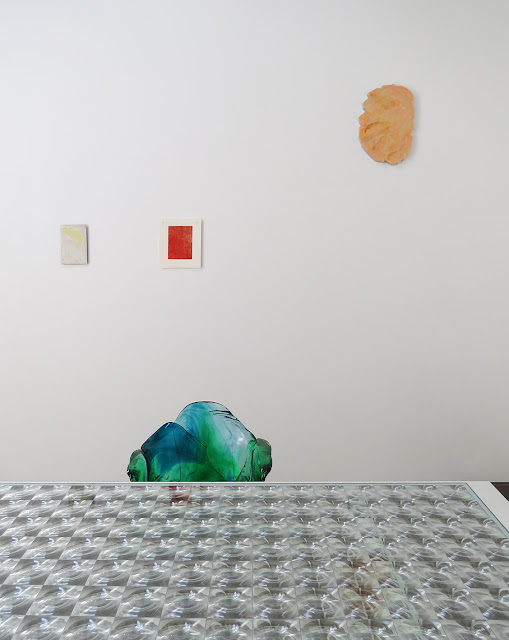
Installation images Ritson + McCook

Installation images[top and below]


Joanne Ritson. Tulip & Crocus[both2003]Pigment& micro cystalline wax on plywood.


Detail Brandt McCook,  Wonder walking, astral bright, 2011-2012

Joanne Ritson, Thallium Sky, 2006, Oil on Linen

Thursday, April 26, 2012


BRANDT McCOOK + JOANNE RITSON
Works grouped by Michael Graf

MAY 2012
GREENWOOD STREET PROJECT
2-6 Thursday & Friday, and by appointment (last day Friday 1 June)
Greenwood Street Project is a creative initiative under the supervision of Donald Holt & Tomislav Nikolic, located in Abbotsford, Victoria.
Greenwood Street Project
9 Greenwood Street
Abbotsford 3067
T: 613 9415 8893


Brandt McCook + Joanne Ritson
Greenwood Street Project, May 2012

I’ve known Brandt McCook and Joanne Ritson for many years. They, however, have never met or seen each other’s work until this exhibition at Greenwood Street Project. Although their work doesn’t resemble each other’s in appearance, I sense parallel modes of seeing and making. In particular, both are drawn to patterned structures and the decorative arts. Before embarking on her current painted works, Ritson’s preferred format was coloured wax, which formed intricate inlaid reliefs. Although recalling pietra dure and marquetry, these works incorporate drips and splashes that highlight their molten origin. McCook, likewise, constructs small panels made from tiny sections of plastic shopping bags. This technique resembles a master making a stained glass window, however abject McCook’s choice of media. Because of the vulnerable nature of the materials they employ, doubts are raised about the long-term preservation of Ritson and McCook’s work. It assumes a compelling pathos that runs counter to the artisan techniques the two artists reference - stained glass and inlaid stone or wood. Perhaps forewarned, both Ritson and McCook have shifted from wax and plastic to paper and canvas. Sensibilities that informed their earlier working methods are transferred to these new media. Ritson’s paintings mimic the look of molten wax whilst exploring subtle spatialities that were limited with her previous technique. McCook’s charcoal drawings of aerial views of wooded landscapes draw on the map-like quality of his sectioned plastic panels, now enlivened with an abundance of naturalistic detail. And here arises an unexpected point of contact between these two artists. Both have turned to landscape as a subject, but from strikingly different paths. Ritson’s “chemical” terrains are adapted from images of microbiology, whilst McCook’s woods (as indeed is the patterning of his plastic panels) are formed from the shapes of words and phrases. Rather than depictions of actuality, I would designate these works as a form of self-portraiture, so closely are they aligned to aspects of their makers identities. 

I anticipate further insights to arise from this “forced encounter” over the next four weeks.


Michael Graf
Melbourne, April 2012


Tuesday, April 3, 2012

A LOOSE HARNESS FOR TIME

  
  Installation Photograph


   Leslie Wayne, What Goes In , 2000
  Oil on Wood , 
  14 x 12 x 2.5 inches
  Private Collection


   Leslie Wayne, What Goes In , 2000 [detail]


    Linda Ann Stark, Aqua Pulse,[diptych] 1995-96 
  Oil on Canvas on Panel,
  18 x 18 x 3.5 cm each
  Private Collection


    Linda Ann Stark, Aqua Pulse , 1995-96 [detail]

    Tomislav Nikolic, Mutable, position six , 2010
  Acrylic & marble dust, Radiata pine,
  67x50x50cm
  Courtesy of Jensen Gallery, Sydney.

    Tomislav Nikolic, Mutable, position six , 2010 [detail]

  This project is under the supervision of Donald Holt.

Sunday, April 1, 2012

A LOOSE HARNESS FOR TIME

A LOOSE HARNESS FOR TIME
APRIL 2012
GREENWOOD STREET PROJECT

The repetitive process in these artists method is a unifying element in this presentation of works by Linda Ann Stark, Tomislav Nikolic & Leslie Wayne.
The protracted nature of their production is separated by each artist’s use of temporal space: a critical difference that releases the works to the viewer. Each imbues a second time frame particular to their making, material and display.
Whether through optical tension, the performative nature of intervention or a planned release into entropy, the works making is considered with time as the vehicle to be controlled and released, a medium with its own viscosity.


Sunday, March 11, 2012

Sandra Bridie| colour + form : art + play


Sandra Bridie   
colour + form : art + play (a fiction)


Left to right: Sandra Bridie, Hilary Sorensen and daughter, Brian Hutting, c+f: art + play, Adjacent Space Birmingham UK,1975


Imagine if Bauhaus master Ludwig Hirschfeld Mack had spawned an artists group in Melbourne in the early 1960s. Using this hypothesis, Melbourne artist Sandra Bridie has invented a fictional artists group called colour + form.

The fiction: colour + form was created by three student teachers who met at Kew Kindergarten College in 1958. Inspired by their lecturer, Bauhaus master Ludwig Hirschfeld Mack, and the aesthetic of formalism and its pedagogical possibilities that he introduced them to, Brian Hutting, Hilary Sorensen and Sandra Bridie decided to embark on a series of art projects outside of college hours, using simple colours and forms.
In 1960, after leaving college, Hutting, Sorensen and Bridie distilled their ideas for their project further; they formulated a series of conceptual constraints and wrote a brief manifesto – and an artists group was born. Called colour + form, the parameters the group set themselves were minimal: a basic geometric form attached to a primary colour was allocated to each member, and they would produce work purely from that form and in that colour. The allocations were as follows: Brian Hutting: Blue Triangle, Hilary Sorensen: Red Circle, Sandra Bridie: Yellow Rectangle. From this seemingly straitened premise, a surprising array of both serious and playful possibilities emerged that have generated an extensive collection of artworks, events and publications that the group continue to produce to this day.
Now in their mid-seventies and laying claim to being the longest running abstract art movement in Australia, c+f has an extensive exhibiting history as a group and as individuals within Australia, Europe and South America. These include numerous collaborations or 'intersections' with international groups such as GRAV (Groupe de Recherche d'Art Visuel, Paris (1960-68) and the Neo-Concret movement in Brazil (1959-61).
This exhibition, colour + form : art + play, re-enacts a series of interactive installation works first presented by the group in the 1970s.
Sandra Bridie is a Melbourne-based artist curator. Her solo practice involves the invention of fictional artists who sometimes bear her own name, imagined into the Melbourne art landscape of the 20th and 21st centuries. This ongoing conceit allows Bridie to play out numerous possibilities for the artist within a familiar locale.
Using altered PMP (Perceptual Motor Program) equipment, on loan from Eltham Primary School, Bridie presents a primary-coloured, geometric-interactive play environment. Please be prepared to remove your shoes for play.

22–31 March 2012
GREENWOOD STREET PROJECT: 9 Greenwood Street Abbotsford, 3067 
Hours open: 2-5pm Thursday to Saturday or by appointment  
Contact Sandra Bridie: 0417 232 594  bridiesandra@gmail.com  www.sandrabridie.com


Wednesday, November 2, 2011

Glob Life: Photographs by Peter Lambropoulos

Escape to another dimension

For the world to be interesting, you have to be manipulating it all the time.― Brian Eno

You want to see the Wizard? But nobody can see the Great Oz. Even I have never seen him.― “Wizard of Oz”

Peter Lambropoulos’s photographic images function as an immaculate disguise for their genesis. In his works we behold a world unto itself, celestial spaces seemingly free of the imposition of human signification ― an escape into another dimension. And yet, in observing these otherworldy landscapes and the strange forms that inhabit them, the urge to anthropomorphise is irresistible. His images play on our need to identify, to contextualise, just as they take us somewhere limitless and unknowable.

If you are ever privileged enough to see Peter Lambropoulos’s ‘studio’, you will be directed to a tiny section of the wardrobe in the artist’s bedroom. He describes a perverse enjoyment of his low-tech operation: a jerry-built affair of makeshift lights, cellophane filters and cardboard backdrops that belies the technical precision of the resulting images we see hung on the gallery wall. Here is where the artist plays with his miniature theatre ― performing, as he puts it, a “dance between me, my subject and the camera” ― to create an image that will play with our minds.

Like the Wizard of Oz, secretly manipulating his levers and contraptions to generate his grand optical illusions, Lambropoulos is a trickster-photographer, weaving his magic in his tiny cupboard-studio. The objects crafted by the artist to populate his compositions include teensy glass sculptures; amorphous shapes cast in gelatine, ice or silicone; translucent crystals that cling to sticks or wire; and the occasional found object.


But photographed, these diminutive subjects cease to represent themselves in their actuality. Instead they are transformed into active life-forms, like animals caught in the headlights, exploring their vast, enigmatic dreamscapes. Fantastical vegetation and unearthly creatures emerge from their garish terrain, reaching out into limitless space. Deliberately contrived, the artwork becomes a perfect disguise for all the fiddly human manipulation that has gone on behind the scenes.

Lambropoulos says he wants to create a “visual conundrum” with his works, exploiting our instinctive desire to resolve any image that we can’t immediately pin down. Through his use of semi-abstraction and spatial distortion, the images become suggestive of familiar forms, but we are never given the satisfaction of making sense of their scale or their relationship to the real world. 

Viewers are inclined to make swift interpretations, only to come up against another set of questions: “Is it macro? Micro? Galactic?” the artist teases. “You don’t know what you’re looking at or what the context is, so there’s lots of room for the imagination to play.”

At first sight, the worlds Lambropoulos constructs appear beautiful in the purist sense. Objects sparkle with reflected light, a rainbow spectrum bouncing off their surfaces. The terrain blurs, collapsing into blackness or merging with gradations of pure colour. But the longer we look, the more the visceral impact of the image takes hold: the colours a bit too lurid, the organisms vaguely grotesque. Though not shy of the cute, or the humorous, or even the pretty, nothing is ever quite so straightforward. Always, in his images, Lambropoulos is toying with that abject space between repulsion and fascination.

No matter how hard we try to figure these curious images out, our capacity to grasp the perspective is confounded. Optical illusions reign. Is that a vast, black lake stretched between two mountain ranges, or just an infinite void? Is that an arctic peak rising out of its glacial landscape, or merely the blue opening at the centre of a ring of ice, suspended in its unknowable cosmos? If that is the eye of a creature gliding through green water, why is there something too thin and stumpy where its fin should be? There is something acutely disturbing in a landscape we can’t comprehend; in a creature that seems to embody energy but has no features with which to see or hear. 


As human viewers, we can’t help but look at two glass blobs leaning toward each other and perceive a communication between them; we look at a spindly tendril tentatively reaching into space and detect a yearning. No matter how aware of the artifice at play, we find ourselves strangely moved.

There is a lush intimacy to Lambropoulos’s photographs, which invite us to admire his timeless fantasy world in magnified detail. Like the soundscapes created in electronic music, the human element has become indiscernible, and we are left with something pure and immaculate ― the concept realised, the illusion complete: the artist’s utopian vision. We might like to go there, but this is a pristine world which could only exist in our imaginations. 

We can look, but we can’t touch.

― Rachel Power, 2011